Il titolo sintetizza le conclusioni della teoria esposta in questo blog.
Come vedremo tali considerazioni potrebbero scaturire anche da una semplice analisi di fenomeni fisici noti, caratteristici della Meccanica Quantistica.
L’esperimento della “doppia fenditura"per esempio, mostra come un’onda elettromagnetica che la sorpassa possa determinare su una lastra fotografica una figura di interferenza (comportamento ondulatorio) o la semplice proiezione delle fenditure (comportamento particellare).
Ma il fotone, alla fine, cos’è veramente, un’onda o un corpuscolo? Se non fosse corpuscolo, non si spiegherebbero fenomeni come l’effetto fotoelettrico; se non fosse onda, non si spiegherebbero effetti come tutta l’ottica geometrica, interferenze e diffrazioni. La risposta a questa domanda fondamentale è un principio della Meccanica Quantistica : le particelle sono anche onde.
Matematicamente è l’ Equazione di Schroedinger a descrivere il fenomeno. Le sue derivate parziali del secondo ordine la fanno somigliare tantissimo alle normali equazioni dei sistemi ondulatori continui.
Quando, pero', si impongono dei “vincoli” come perturbazioni o buche di potenziale (che di fatto significa che la particella/onda sta subendo l’influenza di un rilevatore/osservatore), l’andamento della funzione d’onda cambia e questa “collassa” in una soluzione o “autostato”, rivelando l’aspetto quantistico, non più continuo, della particella. Non solo i fotoni : anche gli elettroni e tutte le altre particelle come protoni, neutroni e, a dirla tutta, anche noi stessi e i corpi macroscopici hanno una funzione d’onda associata, solo che tanto più il corpo è grande, tanto meno l’aspetto ondulatorio è importante. Così, capita che una particella elementare può, grazie al suo aspetto ondulatorio e alle piccole dimensioni, uscire da una buca di potenziale per "effetto tunnel" , mentre noi, più grossi, abbiamo molte meno probabilità di attraversare un monte grazie allo stesso effetto. Ma attenzione, “meno probabilità”, non zero probabilità ! E’ anche questo il senso che sottende il principio di indeterminazione di Heisenberg. Il non poter separare perfettamente posizione e impulso d’una particella dovrebbe significare che non è possibile separare del tutto uno dei due aspetti, onda e corpuscolo, dall’altro.
Nella teoria gravitazionale di Marius le particelle elementari del “Modello Standard”, come lo stesso spazio fisico, sono costituiti da onde caratterizzate da diverse frequenze e ampiezze di oscillazione. Non esistono, quindi, definiti limiti di separazione tra particelle, ma solo “assetti” stabili della materia che la fisica teorica descrive con modelli discreti.
Stefano Gusman
sabato 6 febbraio 2010

venerdì 5 febbraio 2010
Expanding universe ?
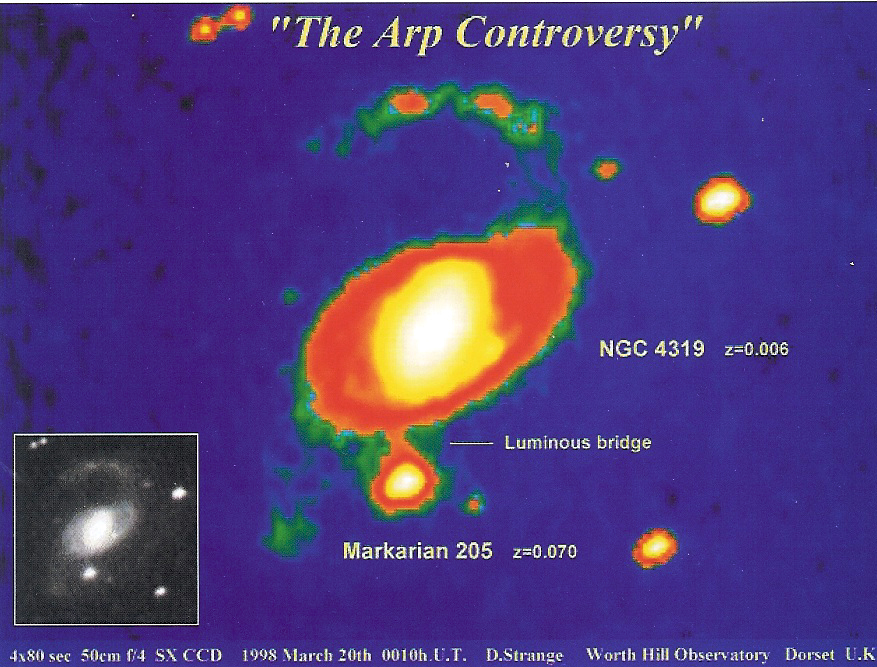
Does it do ? If cosmologic “red shift” is correctly interpreted it would look so. The galaxies recession seems to be an accepted phenomenon, but Halton Arp’s observations show, in an apparently unequivocal main, that heavenly bodies with different red shift and consequently theoretical different speeds and distances from us, really interact, as from photographical documents that show “material bridges” linking the same bodies.


So how it is possible that masses that would have different ages compared to “time zero” of Big Bang are located at the same distance from us that are observing ? There are much theories that try to explain these phenomenon , like “variable mass” one, but the principle of the “initial event” seems to be objectionable.
Does it, perhaps, necessary to consider BB a local event in a stationary universe ?
With reference to the second picture, in an article of Bahcall and others. published in 1992 "The near-ultraviolet spectrum of Markarian 205" it states that: "... NGC 4319 Absorbs some of the light from Mrk 205, just as expected if NGC 4319 is projected in front of Mrk 205."
This is the abstract :
"We report measurements of the absorption and of the emission lines between 1600 and 3200 A in the spectrum of the nearby AGN Markarian 205 (z = 0.071), which lies at a projected distance of 3 kpc (H0 = 100 km/s) from the nucleus of the nearby barred spiral galaxy, NGC 4319 (z = 0.0047). The results were obtained using high-resolution (R = 1300) observations with the Faint Object Spectrograph of the HST. A total of 15 absorption lines, 13 of which are produced by Galactic gas, and four AGN emission lines are detected. Two of the absorption lines, the Mg II resonant doublet, are produced by gas in the intervening galaxy NGC 4319. This is the first detection of absorption due to intervening gas in this famous quasar-galaxy pair".
The logic is as follows : lets suppose that we have a galaxy "A" and a quasar "B" appearing to have overlapping, but with different redshift. The galaxy has z = 0.1, the quasar z = 0.2. The galaxy at z = 0.1 can 'produce a spectral absorption on the radiation that comes from quasar at z = 0.2 away, according with Hubble’s law that states redshift bound in proportional way to the distance from the observer. The two objects are close only prospectively. The absorption lines have, in fact, redshift 0.1. If we would find the reverse situation, that is B imprinting absorption lines, but with 0.2 redshift. evidently the correlation between red shift and distance would be falsified.
So far, has been found the first case, never the second.
BB is a "relativistic" theory that backwards in the universe history since to a "singularity" where mathematically "diverges" and is not "renormalizable" that is that the infinites of asymptotic solutions are not removable. This happens cause, taking off space to matter, you constrain space time curvature to be "absolute" and not relative and so you "force" it to make a role that can't act : to explain gravity force.
But let’s return to galaxies recession and to the so called “dark energy” that one, for understand, that would give the field of force that put away (or bring near) the heavenly bodies. In the hypothesis of a “stationary” universe Einstein identified it as the “cosmologic constant” disowned by himself successively. Today it talks also about “zero point” energy or vacuum specific energy to justify the acceleration between galaxies. The actual target of experimental research is the “adaptation” of General Relativity to Quantum Mechanics, trying to detect the quantum mediator of gravitational force (the graviton).
The problem is that gravitational theory of GR was thought for a continuous space time not for a quantized one, so the existence of gravitational quantum would be an internal contradiction of the same theory.
The Marius gravitational theory inquires into what could be the real physical nature of this “universal engine”.
Stefano Gusman.
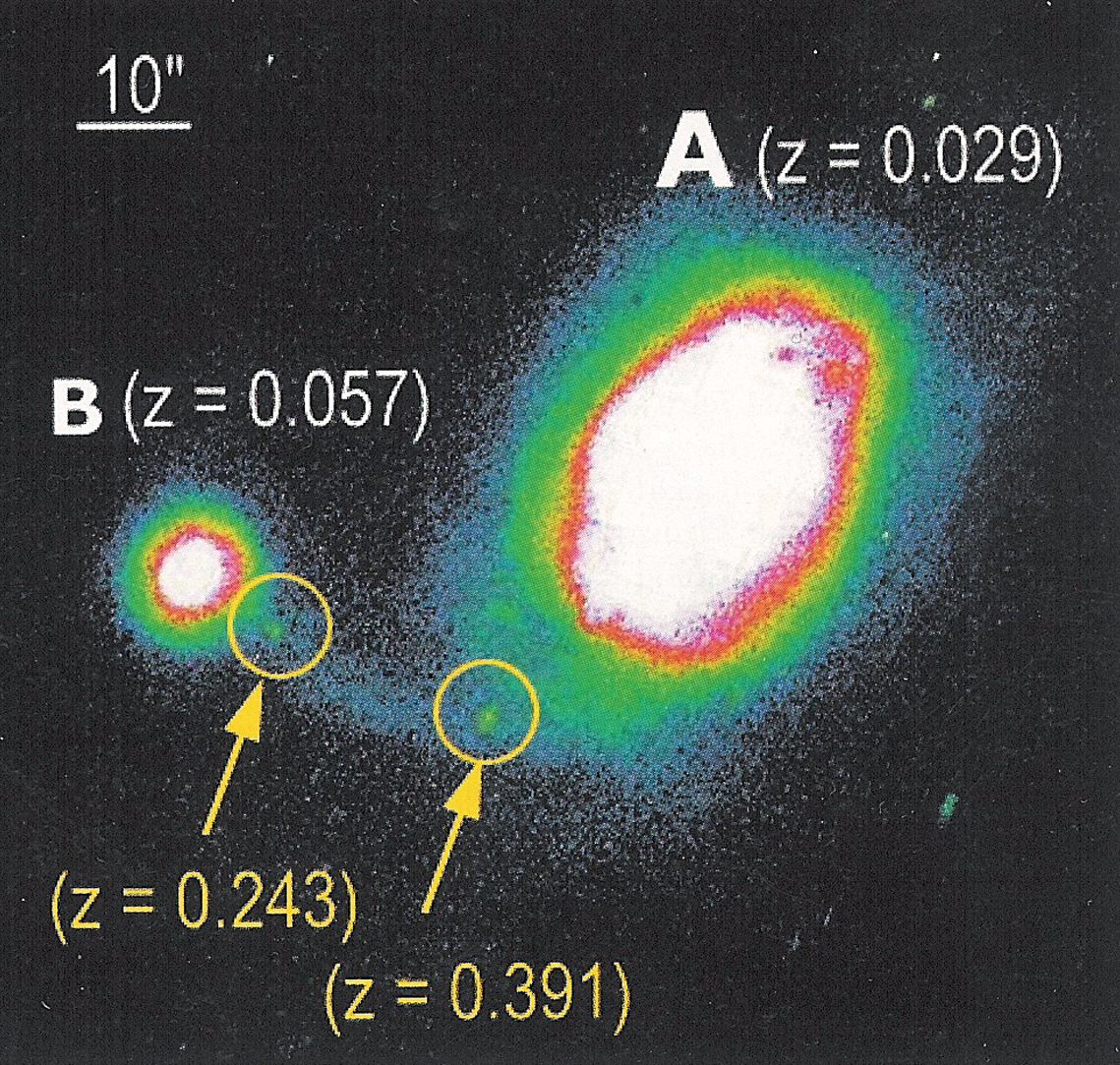
So how it is possible that masses that would have different ages compared to “time zero” of Big Bang are located at the same distance from us that are observing ? There are much theories that try to explain these phenomenon , like “variable mass” one, but the principle of the “initial event” seems to be objectionable.
Does it, perhaps, necessary to consider BB a local event in a stationary universe ?
With reference to the second picture, in an article of Bahcall and others. published in 1992 "The near-ultraviolet spectrum of Markarian 205" it states that: "... NGC 4319 Absorbs some of the light from Mrk 205, just as expected if NGC 4319 is projected in front of Mrk 205."
This is the abstract :
"We report measurements of the absorption and of the emission lines between 1600 and 3200 A in the spectrum of the nearby AGN Markarian 205 (z = 0.071), which lies at a projected distance of 3 kpc (H0 = 100 km/s) from the nucleus of the nearby barred spiral galaxy, NGC 4319 (z = 0.0047). The results were obtained using high-resolution (R = 1300) observations with the Faint Object Spectrograph of the HST. A total of 15 absorption lines, 13 of which are produced by Galactic gas, and four AGN emission lines are detected. Two of the absorption lines, the Mg II resonant doublet, are produced by gas in the intervening galaxy NGC 4319. This is the first detection of absorption due to intervening gas in this famous quasar-galaxy pair".
The logic is as follows : lets suppose that we have a galaxy "A" and a quasar "B" appearing to have overlapping, but with different redshift. The galaxy has z = 0.1, the quasar z = 0.2. The galaxy at z = 0.1 can 'produce a spectral absorption on the radiation that comes from quasar at z = 0.2 away, according with Hubble’s law that states redshift bound in proportional way to the distance from the observer. The two objects are close only prospectively. The absorption lines have, in fact, redshift 0.1. If we would find the reverse situation, that is B imprinting absorption lines, but with 0.2 redshift. evidently the correlation between red shift and distance would be falsified.
So far, has been found the first case, never the second.
BB is a "relativistic" theory that backwards in the universe history since to a "singularity" where mathematically "diverges" and is not "renormalizable" that is that the infinites of asymptotic solutions are not removable. This happens cause, taking off space to matter, you constrain space time curvature to be "absolute" and not relative and so you "force" it to make a role that can't act : to explain gravity force.
But let’s return to galaxies recession and to the so called “dark energy” that one, for understand, that would give the field of force that put away (or bring near) the heavenly bodies. In the hypothesis of a “stationary” universe Einstein identified it as the “cosmologic constant” disowned by himself successively. Today it talks also about “zero point” energy or vacuum specific energy to justify the acceleration between galaxies. The actual target of experimental research is the “adaptation” of General Relativity to Quantum Mechanics, trying to detect the quantum mediator of gravitational force (the graviton).
The problem is that gravitational theory of GR was thought for a continuous space time not for a quantized one, so the existence of gravitational quantum would be an internal contradiction of the same theory.
The Marius gravitational theory inquires into what could be the real physical nature of this “universal engine”.
Stefano Gusman.
Universo in espansione ?
Si sta espandendo ? Se il “red shift” cosmologico viene correttamente interpretato parrebbe di si. La “recessione” delle galassie è un fenomeno dato per scontato, ma le osservazioni di Halton Arp dimostrano in maniera apparentemente inequivocabile che corpi celesti a diverso red shift e che, quindi, dovrebbero trovarsi a distanze e velocità, rispetto a noi, molto diverse tra loro, in realtà “interagiscono” come da documenti fotografici che evidenziano “ponti di materia” che collegano tali corpi.
Come è possibile, allora, che masse che dovrebbero avere età diverse rispetto al tempo “zero” dell’evento Big Bang, siano alla stessa distanza da noi che le osserviamo ? Molte sono le teorie che cercano di interpretare questi fenomeni, tra cui quella della “massa variabile”, ma il principio dell’evento iniziale mi pare venga ad essere messo in discussione. Forse occorre “derubricare” il BB a evento “locale” in un universo stazionario ?
Con riferimento alla seconda immagine, in un articolo di Bahcall et al. pubblicato nel 1992 "The near-ultraviolet spectrum of Markarian 205". si afferma che :“NGC 4319 assorbe parte della luce emessa da Mrk 205, proprio come ci si aspetterebbe se NGC 4319 fosse prospetticamente davanti a Mrk 205”
L'Abstract dell'articolo è il seguente:
"Riportiamo misurazioni dell’assorbimento e delle righe di emissione tra 1600 e 3200 A nello spettro del vicino AGN Markarian 205 (z = 0,071), che si trova ad una distanza proiettata di 3 kpc (H0 = 100 km / s) dal nucleo della vicina galassia a spirale barrata NGC 4319 (z = 0,0047). I risultati sono stati ottenuti utilizzando osservazioni ad alta risoluzione (R = 1300) con lo spettrografo Faint Object del HST. Vengono rilevati un totale di 15 righe di assorbimento, di cui 13 prodotte da gas galattico, e quattro righe di emissione AGN. Due delle righe di assorbimento, il doppietto di risonanaza Mg II, sono prodotte da gas nella galassia NGC 4319. Questa è la prima rilevazione di assorbimento dovuto a gas a causa in questo famosa coppia galassia-quasar ".
La logica e' la seguente : supponiamo di avere una galassia “A” e un quasar “B” che appaiono sovrapposti ma che hanno redshift differenti. La galassia ha z=0.1, il quasar z=0.2. La galassia a z=0.1 puo' produrre un assorbimento spettrale sulla radiazione che gli arriva dal quasar a z=0.2 piu' lontano. Cio' secondo la tesi che vuole il redshift legato, in maniera proporzionale, alla distanza dall’osservatore secondo la Legge di Hubble. I due oggetti sono vicini solo prospetticamente. Le linee di assorbimento hanno, appunto, il redshift di 0.1. Se trovassimo la situazione inversa, vale a dire che sia B ad imprimere linee di assorbimento, che pero' avranno redshift di 0.2, evidentemente la correlazione tra red shift e distanza sarebbe falsificata.
Finora si e' rinvenuto il primo caso, mai il secondo.
Il BB è una teoria "relativistica" che percorre "all'indietro" la storia dell'universo fino alla "singolarità" iniziale dove, matematicamente, "diverge" e non è "rinormalizzabile", ovvero gli infiniti asintotici delle soluzioni non sono eliminabili. Cio' accade perchè tale teoria, sottraendo spazio alla materia, costringe la curvatura dello spazio - tempo ad essere "assoluta" e non "relativa" e a svolgere un ruolo che non gli compete : spiegare la forza di gravità.
Ma torniamo alla recessione delle galassie e alla cosiddetta energia “oscura” quella, per intenderci, che servirebbe a fornire il campo di forza che potrebbe allontanare (o avvicinare) i corpi celesti. Einstein, nell’ipotesi di universo stazionario, la identifico’ nella costante cosmologica da lui stesso successivamente disconosciuta. Oggi si parla anche di energia “di punto zero” o energia specifica del vuoto per giustificare l'accelerazione relativa tra galassie.
L’obiettivo attuale della ricerca sperimentale è quello di confermare l’adattabilità della Relatività Generale alla Meccanica Quantistica tentando di rilevare i mediatori quantistici della forza di gravità (i gravitoni). Il problema è che la teoria gravitazionale della RG fu pensata per uno spazio – tempo continuo non quantizzato, quindi l’esistenza di quanti gravitazionali sarebbe una contraddizione intrinseca alla stessa natura dello spazio – tempo curvo responsabile del campo di accelerazione gravitazionale.
La teoria di Marius si propone di indagare su quale possa essere la reale natura fisica di questo “motore” dell’universo.
Stefano Gusman.
Come è possibile, allora, che masse che dovrebbero avere età diverse rispetto al tempo “zero” dell’evento Big Bang, siano alla stessa distanza da noi che le osserviamo ? Molte sono le teorie che cercano di interpretare questi fenomeni, tra cui quella della “massa variabile”, ma il principio dell’evento iniziale mi pare venga ad essere messo in discussione. Forse occorre “derubricare” il BB a evento “locale” in un universo stazionario ?
Con riferimento alla seconda immagine, in un articolo di Bahcall et al. pubblicato nel 1992 "The near-ultraviolet spectrum of Markarian 205". si afferma che :“NGC 4319 assorbe parte della luce emessa da Mrk 205, proprio come ci si aspetterebbe se NGC 4319 fosse prospetticamente davanti a Mrk 205”
L'Abstract dell'articolo è il seguente:
"Riportiamo misurazioni dell’assorbimento e delle righe di emissione tra 1600 e 3200 A nello spettro del vicino AGN Markarian 205 (z = 0,071), che si trova ad una distanza proiettata di 3 kpc (H0 = 100 km / s) dal nucleo della vicina galassia a spirale barrata NGC 4319 (z = 0,0047). I risultati sono stati ottenuti utilizzando osservazioni ad alta risoluzione (R = 1300) con lo spettrografo Faint Object del HST. Vengono rilevati un totale di 15 righe di assorbimento, di cui 13 prodotte da gas galattico, e quattro righe di emissione AGN. Due delle righe di assorbimento, il doppietto di risonanaza Mg II, sono prodotte da gas nella galassia NGC 4319. Questa è la prima rilevazione di assorbimento dovuto a gas a causa in questo famosa coppia galassia-quasar ".
La logica e' la seguente : supponiamo di avere una galassia “A” e un quasar “B” che appaiono sovrapposti ma che hanno redshift differenti. La galassia ha z=0.1, il quasar z=0.2. La galassia a z=0.1 puo' produrre un assorbimento spettrale sulla radiazione che gli arriva dal quasar a z=0.2 piu' lontano. Cio' secondo la tesi che vuole il redshift legato, in maniera proporzionale, alla distanza dall’osservatore secondo la Legge di Hubble. I due oggetti sono vicini solo prospetticamente. Le linee di assorbimento hanno, appunto, il redshift di 0.1. Se trovassimo la situazione inversa, vale a dire che sia B ad imprimere linee di assorbimento, che pero' avranno redshift di 0.2, evidentemente la correlazione tra red shift e distanza sarebbe falsificata.
Finora si e' rinvenuto il primo caso, mai il secondo.
Il BB è una teoria "relativistica" che percorre "all'indietro" la storia dell'universo fino alla "singolarità" iniziale dove, matematicamente, "diverge" e non è "rinormalizzabile", ovvero gli infiniti asintotici delle soluzioni non sono eliminabili. Cio' accade perchè tale teoria, sottraendo spazio alla materia, costringe la curvatura dello spazio - tempo ad essere "assoluta" e non "relativa" e a svolgere un ruolo che non gli compete : spiegare la forza di gravità.
Ma torniamo alla recessione delle galassie e alla cosiddetta energia “oscura” quella, per intenderci, che servirebbe a fornire il campo di forza che potrebbe allontanare (o avvicinare) i corpi celesti. Einstein, nell’ipotesi di universo stazionario, la identifico’ nella costante cosmologica da lui stesso successivamente disconosciuta. Oggi si parla anche di energia “di punto zero” o energia specifica del vuoto per giustificare l'accelerazione relativa tra galassie.
L’obiettivo attuale della ricerca sperimentale è quello di confermare l’adattabilità della Relatività Generale alla Meccanica Quantistica tentando di rilevare i mediatori quantistici della forza di gravità (i gravitoni). Il problema è che la teoria gravitazionale della RG fu pensata per uno spazio – tempo continuo non quantizzato, quindi l’esistenza di quanti gravitazionali sarebbe una contraddizione intrinseca alla stessa natura dello spazio – tempo curvo responsabile del campo di accelerazione gravitazionale.
La teoria di Marius si propone di indagare su quale possa essere la reale natura fisica di questo “motore” dell’universo.
Stefano Gusman.
What about weight ?
Weight definition : P = m g where m is a constant and g variable. In other words weight is the “effect” of gravitational acceleration on a body with mass equal to m.
More complex is to define clearly the concept of mass. In general way the mass could be explained as the quantity of matter into the volume of a body. So, on equal volume, weight is proportional to the quantity of matter contained, that is density. Then the more compact bodies are the more heavy too. The thrust that we feel under our foot is the reaction of the surface on which we are pushed on. This effect is as bigger as greater density and, consequently, smaller the compressibility. The deformations generated by a force aging on a elastic body, in fact, induces also an internal state of tensions as bigger as greater Elasticity Modulus distinctive of the material constituting the body.
For Einstein every body is in freefall. The Sun towards the centre of the galaxy, the Earth towards the Sun, Moon towards the Earth and us towards the centre of the Earth. The reason would be that space – time is curved by masses, and curvature is greater where mass density is bigger. So would be a curvature gradient bending the “lines of universe”. When a surface opposes resistence to freefall motion we feel the weight as on earthly surface. Really also all along our body would be a curvature gradient, therefore going on deeply underground we would be more and more bent and we would see our clock going more and more slower, with our brain getting old more quickly then our feet. But how can it’s possible if in the local system space time stands plane ?
An observer on the earthly surface is subject to a gravitational acceleration field directed toward the center of the Earth then, for the second postulate of GR, stands on a non-inertial platform. It should therefore also stand in a curve space - time. In reality there is no free fall motion of the observer toward the center of the Earth and without relative motion relativity is not applicable, then space-time is flat. All that unless we postulate that all bodies are by themselves in free fall, a nice "trick" that, howeever, doesen't work. Infact a mass is in free fall only if another mass has previously curved spacetime. But going back in time the first mass/energy created in the Big Bang would be also space and time. There aren’t, in fact, time and space without matter, but you can not say that the matter is first and then space/time and not the other way. They coincide in the same event BB. So there couldn’t be any free fall mass/energy motion due to the spacetime curvature, or curved space-time due to the presence of mass/energy. BB event, in Einstein thought for a "continuous" space-time, was instantaneous.This did not apply to the Copenhagen school, according to which space-time was quantized ; infact GR doesen’t work at quantum sizes as mathematically "diverges" (and is not "renormalizable") in the surroundings of the space-time singularity that, really, BB is. The cat chasing its tail or even the chicken and egg dilemma: who came first ?
In brief a logic "fallacy".
Really, for the same RG, we wouldn’t must feel weight here on the Earth as on a black hole horizon of events.
In this gravitational theory the weight of a body on the Earth is generated by a pressing force equally distributed on its surfaces, from ionosphere to nucleus, with much intense pressures as smaller surfaces.
Stefano Gusman
More complex is to define clearly the concept of mass. In general way the mass could be explained as the quantity of matter into the volume of a body. So, on equal volume, weight is proportional to the quantity of matter contained, that is density. Then the more compact bodies are the more heavy too. The thrust that we feel under our foot is the reaction of the surface on which we are pushed on. This effect is as bigger as greater density and, consequently, smaller the compressibility. The deformations generated by a force aging on a elastic body, in fact, induces also an internal state of tensions as bigger as greater Elasticity Modulus distinctive of the material constituting the body.
For Einstein every body is in freefall. The Sun towards the centre of the galaxy, the Earth towards the Sun, Moon towards the Earth and us towards the centre of the Earth. The reason would be that space – time is curved by masses, and curvature is greater where mass density is bigger. So would be a curvature gradient bending the “lines of universe”. When a surface opposes resistence to freefall motion we feel the weight as on earthly surface. Really also all along our body would be a curvature gradient, therefore going on deeply underground we would be more and more bent and we would see our clock going more and more slower, with our brain getting old more quickly then our feet. But how can it’s possible if in the local system space time stands plane ?
An observer on the earthly surface is subject to a gravitational acceleration field directed toward the center of the Earth then, for the second postulate of GR, stands on a non-inertial platform. It should therefore also stand in a curve space - time. In reality there is no free fall motion of the observer toward the center of the Earth and without relative motion relativity is not applicable, then space-time is flat. All that unless we postulate that all bodies are by themselves in free fall, a nice "trick" that, howeever, doesen't work. Infact a mass is in free fall only if another mass has previously curved spacetime. But going back in time the first mass/energy created in the Big Bang would be also space and time. There aren’t, in fact, time and space without matter, but you can not say that the matter is first and then space/time and not the other way. They coincide in the same event BB. So there couldn’t be any free fall mass/energy motion due to the spacetime curvature, or curved space-time due to the presence of mass/energy. BB event, in Einstein thought for a "continuous" space-time, was instantaneous.This did not apply to the Copenhagen school, according to which space-time was quantized ; infact GR doesen’t work at quantum sizes as mathematically "diverges" (and is not "renormalizable") in the surroundings of the space-time singularity that, really, BB is. The cat chasing its tail or even the chicken and egg dilemma: who came first ?
In brief a logic "fallacy".
Really, for the same RG, we wouldn’t must feel weight here on the Earth as on a black hole horizon of events.
In this gravitational theory the weight of a body on the Earth is generated by a pressing force equally distributed on its surfaces, from ionosphere to nucleus, with much intense pressures as smaller surfaces.
Stefano Gusman
Cos'è il peso ?
Definizione di peso : P = mg, dove m è una costante e g una variabile. In altre parole il peso è l’effetto dell’accelerazione gravitazionale su un corpo di massa m.
Piu’ complesso è definire il concetto di massa. Nei termini piu’ generali possibile potrebbe essere definita come quantità di materia contenuta nel volume di un corpo. Quindi, a parità di volume, il peso è proporzionale alla quantità di materia in esso contenuta, ossia alla densità. Ne consegue che i corpi maggiormente densi sono anche i piu’ pesanti. La spinta che noi avvertiamo sotto i piedi è la reazione della superficie di appoggio al nostro peso. Questo effetto è tanto maggiore quanto piu’ grande è la densità e, quindi, minore la compressibilità. La deformazione generata dall’azione di una forza su un corpo elastico, infatti, induce uno stato di tensioni interne tanto maggiore quanto piu’ grande è il modulo di elasticità proprio del materiale costituente il corpo stesso.
Secondo Einstein tutti i corpi sono in “caduta libera” : il Sole verso il centro della galassia, la Terra verso il Sole, la Luna verso la Terra e i nostri corpi verso il centro di massa della Terra. Il motivo dovrebbe essere che le masse incurvano lo spazio – tempo e la curvatura è piu’ accentuata dove la densità di materia è maggiore. Quindi esiste un “gradiente di curvatura” che piega le “linee di universo”. Se una superficie, ad esempio quella terrestre, si oppone al moto di caduta libera si creano delle forze apparenti come il peso che noi avvertiamo. Quindi anche lungo il nostro steso corpo dovrebbe esistere un sia pur minimo gradiente di curvatura dello spazio – tempo per cui procedendo verso il centro della Terra dovremmo essere sempre piu’ incurvati" e osservare i nostri orologi andare sempre piu’ lentamente. Ma com'è possibile se, localmente, lo spazio – tempo resta piatto ? In realtà, quindi, per la stessa RG, noi non dovremmo avvertire alcun peso, né qui sulla Terra, né sull’orizzonte degli eventi di un buco nero.
Un osservatore posto sulla superficie terrestre è soggetto a un campo di accelerazione gravitazionale diretto verso il centro della terra quindi, per il secondo postulato della RG è su una piattaforma non inerziale. Dovrebbe, quindi, trovarsi anche in uno spazio - tempo curvo. In realtà non esiste alcun moto di caduta libera dell'osservatore verso il centro della terra e senza moto relativo non è applicabile la relatività, dunque lo spazio tempo resta piatto. Tutto cio' a meno di non postulare che tutti i corpi siano di per se in moto di caduta libera, un bel "trucchetto" che, pero’, non regge. Una massa, infatti, è in moto di caduta libera solo se un'altra massa ha preventivamente curvato lo spazio - tempo, ma andando indietro nel tempo la prima massa/energia creatasi con il BB sarebbe stata anche spazio e tempo. Non esistono, infatti, spazio e tempo senza materia, ma non si puo' affermare che venga prima la materia e poi lo spazio/tempo e nemmeno il contrario. Essi coincidono nello stesso evento BB. Quindi non poteva esserci "ab origine" alcun moto di caduta libera di massa/energia dovuta alla curvatura dello spazio tempo, ne curvatura dello spazio tempo dovuta alla presenza di massa/energia. L'evento BB per Einstein che pensava a un "continuo"spazio temporale era istantaneo. Cio’ non valeva per la scuola di Copenhagen secondo la quale lo spazio tempo era quantizzato.E infatti la RG a scale quantistiche non funziona. poichè “diverge” matematicamente (e non è”rinormalizzabile”) negli intorni della singolarità spazio temporale che, appunto, il BB costituisce. Il gatto che si morde la coda o anche il dilemma dell'uovo e della gallina : chi è nato prima ?
In sintesi una "fallacia" logica.
In questa teoria gravitazionale il peso di un corpo sulla Terra è dovuto a una forza compressiva distribuita lungo superfici equipotenziali, dalla ionosfera fino al nucleo, con pressioni tanto piu’ grandi quanto piu’ piccole sono le superfici.Stefano Gusman
giovedì 14 gennaio 2010
Gravitational waves
Why a blog in topic with gravity nature ? Because Marius and I think that it is the mother of all the unanswered questions in cosmology.
In the blog we present a “non conventional” gravitational theory based on classic mechanical principles, on the model of that one theorized by Georges Louis Le Sage
in the half of XVIII century. Particularly, as we’ll see in the next articles, turns out basic the concept of gravity as a compressing force. The goal is to substitute the "unnatural" concepts of "remote action" or space time curvature with a less "metaphysical" model.
In the theory gravitational waves, thought by General Relativity as space time perturbations, are pressing waves of electromagnetic nature in an euclideus three dimensional space. The appearing of reciprocal attraction between two masses in reality turns out to be a simple effect of mutual shield from the waves given by the masses with consequent “decompression” of the surfaces and relative tidal effects.

Earth and Moon, for example, are both subject to a gravitational flow directed towards their internal. The flow is made up by perturbation created by their masses in a space set up by sinusoidal transversal and symmetrical waves that generate, by interference, stationary ones. The first waves, no more balanced, spreads from external to internal of the masses. The flow is proportional to the matter density. Consequently to the "shielding effect" Moon tends to be pushed towards Earth and vice versa. The orbital motion re balances the system.
Interferometers try to detect here on the Earth the waves generated by far highly perturbed systems as those ones of supermassive celestial bodies. Really the same waves would be present also in weakly perturbed systems as the Earth - Moon one. The reason for which these systems are not taken in consideration is that the gravitational “signal” would be too much weak. Moreover anomalies of trajectories of extrasolar space probes Pioneer suggest that effective intensity and range of action of gravitational waves are, probably, bigger than the theoretical ones. Then, if really gravitational waves would be pressing waves, at their passing everything (interferometers including), would be affected by an elastic deformation with the result that, from the “before” to the “after” of the passage, for the instrument wouldn't be any difference. This is the reason for which, for this kind of waves, could be much useful an high sensitive seismograph mounted on gimbals and placed in orbit (for example on SSI), so as not detect the Earth's microseismic events.
Stefano Gusman
In the blog we present a “non conventional” gravitational theory based on classic mechanical principles, on the model of that one theorized by Georges Louis Le Sage
in the half of XVIII century. Particularly, as we’ll see in the next articles, turns out basic the concept of gravity as a compressing force. The goal is to substitute the "unnatural" concepts of "remote action" or space time curvature with a less "metaphysical" model.
In the theory gravitational waves, thought by General Relativity as space time perturbations, are pressing waves of electromagnetic nature in an euclideus three dimensional space. The appearing of reciprocal attraction between two masses in reality turns out to be a simple effect of mutual shield from the waves given by the masses with consequent “decompression” of the surfaces and relative tidal effects.
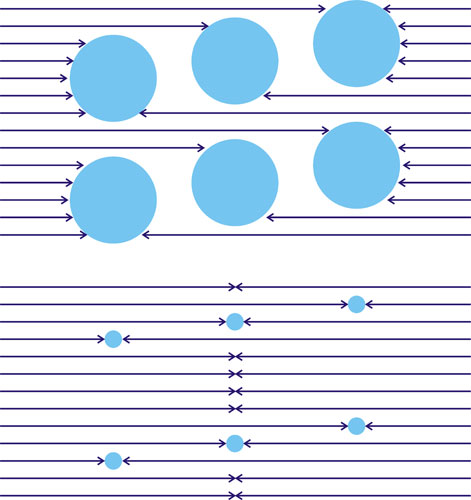
Earth and Moon, for example, are both subject to a gravitational flow directed towards their internal. The flow is made up by perturbation created by their masses in a space set up by sinusoidal transversal and symmetrical waves that generate, by interference, stationary ones. The first waves, no more balanced, spreads from external to internal of the masses. The flow is proportional to the matter density. Consequently to the "shielding effect" Moon tends to be pushed towards Earth and vice versa. The orbital motion re balances the system.
Interferometers try to detect here on the Earth the waves generated by far highly perturbed systems as those ones of supermassive celestial bodies. Really the same waves would be present also in weakly perturbed systems as the Earth - Moon one. The reason for which these systems are not taken in consideration is that the gravitational “signal” would be too much weak. Moreover anomalies of trajectories of extrasolar space probes Pioneer suggest that effective intensity and range of action of gravitational waves are, probably, bigger than the theoretical ones. Then, if really gravitational waves would be pressing waves, at their passing everything (interferometers including), would be affected by an elastic deformation with the result that, from the “before” to the “after” of the passage, for the instrument wouldn't be any difference. This is the reason for which, for this kind of waves, could be much useful an high sensitive seismograph mounted on gimbals and placed in orbit (for example on SSI), so as not detect the Earth's microseismic events.
Stefano Gusman
Onde gravitazionali
Perché un blog “tematico” sulla natura della forza di gravità ? Perché io e Marius pensiamo che sia la madre di tutte le domande senza risposta della fisica cosmologica. Nel blog presentiamo una teoria della gravitazione “non convenzionale” basata su principi meccanici classici, sul modello di quella teorizzata da Georges Louis Le Sage alla metà del XVIII secolo.
In particolare, come si vedrà nei successivi articoli, risulta basilare il concetto di gravità intesa come forza compressiva.
L'obiettivo è quello di sostituire i "controintutivi" concetti di azione "a distanza" o curvatura dello spazio tempo, con un modello meno "metafisico"
Nella teoria le onde gravitazionali, intese dalla Relatività Generale quali perturbazioni dello spazio – tempo, sono onde di pressione di natura elettromagnetica di un normale spazio tridimensionale.
L’effetto di reciproca attrazione tra due masse risulta, in realtà, essere un semplice effetto di mutua “schermatura” dalle onde con conseguente “decompressione” delle superfici affacciate e relativi effetti mareali.
Terra e Luna, per esempio, sono entrambe soggette a un flusso gravitazionale diretto verso il loro interno. Il flusso è originato dalla perturbazione creata dalle loro masse in uno spazio costituito da onde sinusoidali trasversali simmetriche che generano, per interferenza, onde stazionarie. Le prime, non piu’equilibrate, si propagano dall’esterno verso l’interno delle masse. Il flusso è proporzionale alla densità di massa. Conseguentemente all'effetto di schermatura, la Luna tende ad essere spinta verso la Terra e viceversa. Il moto orbitale riequilibra il sistema. La Luna, schermando parte della forza comprimente e causando una decompressione sulla terra, genera l’effetto di marea.
Gli interferometri cercano di rilevare le onde gravitazionali generate da sistemi estremamente lontani e altamente perturbati. In realtà le stesse onde dovrebbero essere presenti anche in sistemi debolmente perturbati come quello Terra – Luna. Il motivo per cui tali sistemi non vengono presi in considerazione è che il “segnale” gravitazionale sarebbe molto debole. Peraltro le anomalie rilevate nelle traiettorie delle sonde extrasolari Pioneer suggeriscono che l’intensità e il raggio di azione delle onde gravitazionali sono, probabilmente, maggiori di quelle teoriche.
Se, quindi, le onde gravitazionali fossero effettivamente onde di pressione al loro passaggio ogni cosa (interferometri compresi) subirebbe una deformazione elastica con il risultato che tra il prima e il dopo il passaggio per lo strumento non vi sarebbe alcuna differenza. Un sismografo ad altissima sensibilità, montato su sistema cardanico e piazzato in orbita, (ad es sulla SSI), in maniera da non rilevare la microsismicità terrestre, potrebbe essere il sistema adatto a rilevare tale tipo di onde.
Stefano Gusman
In particolare, come si vedrà nei successivi articoli, risulta basilare il concetto di gravità intesa come forza compressiva.
L'obiettivo è quello di sostituire i "controintutivi" concetti di azione "a distanza" o curvatura dello spazio tempo, con un modello meno "metafisico"
Nella teoria le onde gravitazionali, intese dalla Relatività Generale quali perturbazioni dello spazio – tempo, sono onde di pressione di natura elettromagnetica di un normale spazio tridimensionale.
L’effetto di reciproca attrazione tra due masse risulta, in realtà, essere un semplice effetto di mutua “schermatura” dalle onde con conseguente “decompressione” delle superfici affacciate e relativi effetti mareali.
Terra e Luna, per esempio, sono entrambe soggette a un flusso gravitazionale diretto verso il loro interno. Il flusso è originato dalla perturbazione creata dalle loro masse in uno spazio costituito da onde sinusoidali trasversali simmetriche che generano, per interferenza, onde stazionarie. Le prime, non piu’equilibrate, si propagano dall’esterno verso l’interno delle masse. Il flusso è proporzionale alla densità di massa. Conseguentemente all'effetto di schermatura, la Luna tende ad essere spinta verso la Terra e viceversa. Il moto orbitale riequilibra il sistema. La Luna, schermando parte della forza comprimente e causando una decompressione sulla terra, genera l’effetto di marea.
Gli interferometri cercano di rilevare le onde gravitazionali generate da sistemi estremamente lontani e altamente perturbati. In realtà le stesse onde dovrebbero essere presenti anche in sistemi debolmente perturbati come quello Terra – Luna. Il motivo per cui tali sistemi non vengono presi in considerazione è che il “segnale” gravitazionale sarebbe molto debole. Peraltro le anomalie rilevate nelle traiettorie delle sonde extrasolari Pioneer suggeriscono che l’intensità e il raggio di azione delle onde gravitazionali sono, probabilmente, maggiori di quelle teoriche.
Se, quindi, le onde gravitazionali fossero effettivamente onde di pressione al loro passaggio ogni cosa (interferometri compresi) subirebbe una deformazione elastica con il risultato che tra il prima e il dopo il passaggio per lo strumento non vi sarebbe alcuna differenza. Un sismografo ad altissima sensibilità, montato su sistema cardanico e piazzato in orbita, (ad es sulla SSI), in maniera da non rilevare la microsismicità terrestre, potrebbe essere il sistema adatto a rilevare tale tipo di onde.
Stefano Gusman
domenica 10 gennaio 2010
LHC - ALICE
L’esperimento “Alice” , programmato nell’ambito delle attività del Large Hadron Collider, prevede la collisione fra nuclei di atomi pesanti (Piombo) per rilevare un plasma di quark e gluoni. Nell’accezione comune del termine un plasma è uno stato della materia, elettricamente neutro nel suo complesso, costituito da elettroni e ioni, ma in questo caso la carica complessiva sarebbe quella fornita dalle cariche frazionarie, positive e negative, dei quark. La maniera di manifestarsi di tale plasma dovrebbe essere uno spettro di emissione continuo.
Nel modello atomico di Shroedinger la carica elettrica negativa dell’elettrone è dispersa in una “nuvola” di probabilità attorno al nucleo, in accordo con la doppia natura corpuscolare-ondulatoria dell’elettrone. Sarebbe allora lecito supporre che anche la carica elettrica positiva possa essere trasportata da un’onda, soprattutto in un plasma. Non ci sarebbe, allora, una netta linea di demarcazione fra due quark, fra un quark e un gluone, fra un protone e un elettrone. Un quark sarebbe costituito da onde ad altissima frequenza e confinato da uno spazio oscillante a frequenze ancora superiori. Si ipotizzi uno spazio costituito da onde trasversali sinusoidali con uguali ampiezza e frequenza, simmetricamente polarizzate che si propagano con velocità uguali e opposte. Tali onde potrebbero essere assimilate ai campi elettrico e magnetico di una radiazione, ma la spinta sarebbe equivalente a quella che si propaga su una corda. D’altronde le onde elettromagnetiche trasportano quantità di moto e momento angolare. Tali onde genererebbero per interferenza onde stazionarie, senza propagazione di energia, ma soltanto presenza di energia potenziale tanto piu’ elevata quanto maggiore fosse la frequenza.
Quando una massa dovesse rompere questa simmetria dello spazio oscillante alcuni treni d’onda comincerebbero a propagarsi creando una pressione sulla superficie della massa stessa. Per ovvie ragioni due masse sarebbero spinte l’una verso l’altra. Questa potrebbe essere una possibile spiegazione dell’effetto Casimir e dell’energia “di punto zero”. La struttura “fine” della materia sarebbe uno spazio caratterizzato da un’energia “specifica” espressa in Joule/m^3 (che non per caso sono le dimensioni anche di una pressione espressa in Pascal), proporzionale alla frequenza delle oscillazioni. In questo tipo di spazio un quark sarebbe inevitabilmente compresso e due quark fortemente compressi l’uno contro l’altro, dando ragione delle interazioni nucleari “forti” previste dal modello standard. Per non collassare il quark deve opporre una sufficiente quantità di energia cinetica fornita dalle oscillazioni interne.
La rottura dei componenti del nucleo atomico porebbe rompere anche questi equilibri per cui da un lato si avrebbe il rilascio dell’energia interna dei quark non piu’ confinata, come avviene per il rilascio di una molla compressa e dall’altro si avrebbe un flusso di onde di energia diretto verso lo spazio lasciato libero dai quark, con la possibile creazione di mini buchi neri che, rapidamente, evaporerebbero (emetterebbero, cioe’, la cosiddetta radiazione di Hawking , in quanto accumulerebbero molta energia in un volume ristretto e dovrebbero rilasciarne una parte per ristabilire l’equilibrio con lo spazio circostante.
Anche nel modello standard avremmo, cosi’, un reale continuo fisico come quello inizialmente pensato da Einstein per la sua teoria gravitazionale. Il campo di Higgs sarebbe equivalente al campo gravitazionale, ma senza bosoni, bensì con un solo tipo di materia oscillante a frequenze differenti, in accordo con il principio di indeterminazione di Heisemberg che impedisce di stabilire con precisione la posizione e la quantità di moto di una particella elementare. Non esisterebbe, quindi, alcuna singolarità, ma solo un normale spazio elastico tridimensionale in grado di espandersi o contrarsi a seconda delle necessità.
Nel 1936 il fisico Carl D. Anderson, alle prese con i raggi cosmici in cerca di tutt'altro, scoprì per caso il muone e subito dopo esclamò: "e questo qui, chi l'ha ordinato?" Quando i livelli di energia raggiunti in LHC saranno sufficientemente elevati le particelle rivelate dagli impatti saranno sempre piu' numerose e i fisici avranno sempre piu' difficoltà a trovare nuovi nomi da attribuirgli e sicuramente a qualcuno di loro sfuggirà un " e questi qui chi li ha ordinati ?". Alla fine, le particelle potrebbero non essere piu' distinguibili dal plasma di energia in cui fossero immerse (oppure non ci saranno abbastanza nomi astrusi da inventare).
Marius ed io pensiamo, invece, che Alice fornirà indizi utili a definire la reale struttura fine dello spazio fisico che un tempo era chiamato etere.
Stefano Gusman
Nel modello atomico di Shroedinger la carica elettrica negativa dell’elettrone è dispersa in una “nuvola” di probabilità attorno al nucleo, in accordo con la doppia natura corpuscolare-ondulatoria dell’elettrone. Sarebbe allora lecito supporre che anche la carica elettrica positiva possa essere trasportata da un’onda, soprattutto in un plasma. Non ci sarebbe, allora, una netta linea di demarcazione fra due quark, fra un quark e un gluone, fra un protone e un elettrone. Un quark sarebbe costituito da onde ad altissima frequenza e confinato da uno spazio oscillante a frequenze ancora superiori. Si ipotizzi uno spazio costituito da onde trasversali sinusoidali con uguali ampiezza e frequenza, simmetricamente polarizzate che si propagano con velocità uguali e opposte. Tali onde potrebbero essere assimilate ai campi elettrico e magnetico di una radiazione, ma la spinta sarebbe equivalente a quella che si propaga su una corda. D’altronde le onde elettromagnetiche trasportano quantità di moto e momento angolare. Tali onde genererebbero per interferenza onde stazionarie, senza propagazione di energia, ma soltanto presenza di energia potenziale tanto piu’ elevata quanto maggiore fosse la frequenza.
Quando una massa dovesse rompere questa simmetria dello spazio oscillante alcuni treni d’onda comincerebbero a propagarsi creando una pressione sulla superficie della massa stessa. Per ovvie ragioni due masse sarebbero spinte l’una verso l’altra. Questa potrebbe essere una possibile spiegazione dell’effetto Casimir e dell’energia “di punto zero”. La struttura “fine” della materia sarebbe uno spazio caratterizzato da un’energia “specifica” espressa in Joule/m^3 (che non per caso sono le dimensioni anche di una pressione espressa in Pascal), proporzionale alla frequenza delle oscillazioni. In questo tipo di spazio un quark sarebbe inevitabilmente compresso e due quark fortemente compressi l’uno contro l’altro, dando ragione delle interazioni nucleari “forti” previste dal modello standard. Per non collassare il quark deve opporre una sufficiente quantità di energia cinetica fornita dalle oscillazioni interne.
La rottura dei componenti del nucleo atomico porebbe rompere anche questi equilibri per cui da un lato si avrebbe il rilascio dell’energia interna dei quark non piu’ confinata, come avviene per il rilascio di una molla compressa e dall’altro si avrebbe un flusso di onde di energia diretto verso lo spazio lasciato libero dai quark, con la possibile creazione di mini buchi neri che, rapidamente, evaporerebbero (emetterebbero, cioe’, la cosiddetta radiazione di Hawking , in quanto accumulerebbero molta energia in un volume ristretto e dovrebbero rilasciarne una parte per ristabilire l’equilibrio con lo spazio circostante.
Anche nel modello standard avremmo, cosi’, un reale continuo fisico come quello inizialmente pensato da Einstein per la sua teoria gravitazionale. Il campo di Higgs sarebbe equivalente al campo gravitazionale, ma senza bosoni, bensì con un solo tipo di materia oscillante a frequenze differenti, in accordo con il principio di indeterminazione di Heisemberg che impedisce di stabilire con precisione la posizione e la quantità di moto di una particella elementare. Non esisterebbe, quindi, alcuna singolarità, ma solo un normale spazio elastico tridimensionale in grado di espandersi o contrarsi a seconda delle necessità.
Nel 1936 il fisico Carl D. Anderson, alle prese con i raggi cosmici in cerca di tutt'altro, scoprì per caso il muone e subito dopo esclamò: "e questo qui, chi l'ha ordinato?" Quando i livelli di energia raggiunti in LHC saranno sufficientemente elevati le particelle rivelate dagli impatti saranno sempre piu' numerose e i fisici avranno sempre piu' difficoltà a trovare nuovi nomi da attribuirgli e sicuramente a qualcuno di loro sfuggirà un " e questi qui chi li ha ordinati ?". Alla fine, le particelle potrebbero non essere piu' distinguibili dal plasma di energia in cui fossero immerse (oppure non ci saranno abbastanza nomi astrusi da inventare).
Marius ed io pensiamo, invece, che Alice fornirà indizi utili a definire la reale struttura fine dello spazio fisico che un tempo era chiamato etere.
Stefano Gusman
venerdì 8 gennaio 2010
ALICE
The “Alice” experiment, projected in Large Hadron Collider, involves the collision between heavy nucleus (Pb) to detect a quark – gluon plasma. In the common meaning the plasma is a state of matter, electrically neutral, composed by electrons and ions, but in this case the total charge would be made up by the fractional charges, positive and negative, of the quarks. The main of this plasma to show itself would have to be a continuous spectre of emission.
In the Shroedinger’s atomic model the position of electronic negative charge around the nucleus is scattered in a “cloud” of probability, in agreement with its double nature, point/bullet – wave. So if the electric negative charge can be a wave the positive one could be a wave too aboveall in a plasma. Then there wouldn’t be a definied boundary between two quarks or a quark and a gluon, and so between proton and electron. A quark would be made up by waves with highest frequency and confined by a swinging space with higher frequency to retain them.
Let’s suppose a space set up by transversal sinusoidal waves with same frequency and size, simmetrically polarized, propagating with equals and opposite speed. These ones could be like the fields B and E of electromagnetism, but the thrust would be equivalent to the one that spreads on a cord. Otherwise e.m. waves transport motion quantity and angular moment. Interfering these waves would create stationary ones, without propagation of energy, but only potential one, as bigger as higher the frequency. When a mass would break this simmetry some train of waves would start to propagate and would create a radiant pressure on the mass surface. With obvious considerations two masses would be pushed one towards the other. This would be a possibile explanation of Casimir effect and “zero point” energy. The fine structure of matter could be an “energetic” space characterized by a specific energy, expressed in Joule /m^3 (that are, not for the chance, the dimensions of a pressure expressed in Pascal), proportional to the frequency of oscillations. In this kind of space a mass like a quark would be comprexed on its surface and two quarks pushed one towards the other like happens with "strong nuclear interaction" of standard model.To not collapse the quark would contain a sufficient kinetic energy given by internal waves too.
The break of atomic components of the nucleus would break this balance too so, by one side there would be a release of the internal energy of the quarks like in comprexed springs, by the other side trains of waves would spread towards the spaces leaved by the quarks in possible mini black holes that would quickly evaporate giving out Hawking’s radiation because would accumulate much energy in a little space and would have to release a share of it to re-establish the balance with the surrounding space.
So we should have also in the Standard Model a real "continuum" like Einstein thought, in a first time, for his gravitational theory.
The Higg’s field would be the same thing then the gravity field, without bosons but only one kind of matter swinging in different frequencies, in agreement with Heisemberg’s principle that forbid to locate with precision the position and the motion quantity of a particle. There wouldn’t be any singularity, but a normal 3d elastic space able to expand or contract itself in chance of need.
In 1936 physicist Carl D. Anderson, while he was working with cosmic rays looking for quite another thing, discovered, for the chance, the muon and soon after said : "who's booked this one?". When LHC will achieve sufficient energy particles detected by impacts will be more and more numerous and physicists will be in trouble to name them and sure someone of them would say : "who's booked these ones?". At the end particles could be no more visible separated from energetic plasma in wich they would be contained (otherwise there will be not enough strange names).
Marius and I think that Alice will give a sign of the real fine structure of physical space that one time was called aether.
Stefano Gusman
In the Shroedinger’s atomic model the position of electronic negative charge around the nucleus is scattered in a “cloud” of probability, in agreement with its double nature, point/bullet – wave. So if the electric negative charge can be a wave the positive one could be a wave too aboveall in a plasma. Then there wouldn’t be a definied boundary between two quarks or a quark and a gluon, and so between proton and electron. A quark would be made up by waves with highest frequency and confined by a swinging space with higher frequency to retain them.
Let’s suppose a space set up by transversal sinusoidal waves with same frequency and size, simmetrically polarized, propagating with equals and opposite speed. These ones could be like the fields B and E of electromagnetism, but the thrust would be equivalent to the one that spreads on a cord. Otherwise e.m. waves transport motion quantity and angular moment. Interfering these waves would create stationary ones, without propagation of energy, but only potential one, as bigger as higher the frequency. When a mass would break this simmetry some train of waves would start to propagate and would create a radiant pressure on the mass surface. With obvious considerations two masses would be pushed one towards the other. This would be a possibile explanation of Casimir effect and “zero point” energy. The fine structure of matter could be an “energetic” space characterized by a specific energy, expressed in Joule /m^3 (that are, not for the chance, the dimensions of a pressure expressed in Pascal), proportional to the frequency of oscillations. In this kind of space a mass like a quark would be comprexed on its surface and two quarks pushed one towards the other like happens with "strong nuclear interaction" of standard model.To not collapse the quark would contain a sufficient kinetic energy given by internal waves too.
The break of atomic components of the nucleus would break this balance too so, by one side there would be a release of the internal energy of the quarks like in comprexed springs, by the other side trains of waves would spread towards the spaces leaved by the quarks in possible mini black holes that would quickly evaporate giving out Hawking’s radiation because would accumulate much energy in a little space and would have to release a share of it to re-establish the balance with the surrounding space.
So we should have also in the Standard Model a real "continuum" like Einstein thought, in a first time, for his gravitational theory.
The Higg’s field would be the same thing then the gravity field, without bosons but only one kind of matter swinging in different frequencies, in agreement with Heisemberg’s principle that forbid to locate with precision the position and the motion quantity of a particle. There wouldn’t be any singularity, but a normal 3d elastic space able to expand or contract itself in chance of need.
In 1936 physicist Carl D. Anderson, while he was working with cosmic rays looking for quite another thing, discovered, for the chance, the muon and soon after said : "who's booked this one?". When LHC will achieve sufficient energy particles detected by impacts will be more and more numerous and physicists will be in trouble to name them and sure someone of them would say : "who's booked these ones?". At the end particles could be no more visible separated from energetic plasma in wich they would be contained (otherwise there will be not enough strange names).
Marius and I think that Alice will give a sign of the real fine structure of physical space that one time was called aether.
Stefano Gusman
domenica 3 gennaio 2010
"pushing" gravity
In General Relativity space time is curved by matter ; so it’s been definitively abandoned the vision of gravity as a force generated by a mass, as for the common thought is.
From elsewhere it’s been created the “dark energy” to justify observations showing galaxies with relative speed growing.
But why the attribute dark ? Because this “substance” can't be observed if not by the effects that it produces. But also an electromagnetic radiation with highest frequency couldn’t show itself to the ordinary instruments of measure. And then why to dislocate this energy where it’s much useful to explain unusual gravitational effects, when it would be much more logic to think it uniformely distributed in all the universe, being probably these unknown effects visible also by an hypothetical observer standing in our Hubble’s horizon ?
E.M. radiation is the only known thing that can apply pressure on a surface in empty space.
I think to a normal 3d space that, in symmetric conditions, is perfectly balanced, being set up by transversal sinusoidal waves, symmetrically polarized, interfering with opposite directions and same speed, size and frequency. These waves would generate standing ones without propagation of energy, but only potential one. We would have, in a normal 3d space, a vibrant frame, but when a mass would break this vacuum symmetry some waves trains could spread transporting motion quantity and angular moment as electromagnetic waves do and causing a radiant pressure on masses surfaces. This phenomenon could exists since from the size of matter “fine structure”, but not instrumentally visible if not when waves length is close to the gamma rays one. Then not sub atomic particles, but only one kind of matter swinging with different frequencies and only one force.
This is a possible explanation of Casimir effect, because in this kind of “energetic space" a mass would be compressed and two masses would be pushed one towards the other.
The same force could explain strong interaction between quarks in atomic nucleus where waves length is smaller, but higher frequency and so energy.
In the same way gravity would be a compressive force and movement of galaxies, stars and planets, as sub atomic particles, would be the result of not compensated Poynting vectors in a kind of “hydrodynamic space".
By the other side a single object with equatorial diameter bigger than, about, 200 Km assumes, not for the chance, a spherical configuration, because the sphere is the geometric volume better balanced by external forces (as a sphere submerged in the water). Probably, in the origin, it was a disorganized quantity of matter that surrounding universe has conformed to the spherical configuration, like a press.
In this kind of space every object “floats or proceeds of rectilinear uniform movement, since an external cause disrupts this state” The external cause could be, for example, a second object that moves a volume of balancing space in analogy with Archimede’s law.
As in mechanical sciences, when the polygon of forces is not closed, the two objects are pushed one towards the other and not collide only if they have sufficient motion quantity to balance the thrust of surrounding space.
The orbital motion would be the consequence of the system rebalancing like electron around atomic nucleus does.
I propose some simple and much approximated gravitational models for some internal planets of solar system and Iupiter, to better explain these concepts.
Let’s considerate the system Earth – Sun and suppose to send away Earth from “Roche’s limit ray” of the Sun (the minimum orbital ray that Earth could have had in the past without be destroyed by gravity of the sun), since to the actual orbit.
Dates available are the following ones :
• MT : Earth’s mass = 5,976 x 10^24Kg ;
• RS : Sun’s equatorial ray = 700.000 km = 700.000.000 m ;
• MS : Sun’s mass nearly 330.000 MT = 1,97 x 10^30Kg ;
• G : universal gravitational constant = 6,67259 x 10⁻¹¹ m^3 Kg^-1 sec^-2;
• RLim. : Roche’s limit ray = 2,86 x RS nearly 2.000.000.000 m ;
• Rm. : actual medium Earth’s orbital ray = 150.000.000 Km = 150.000.000.000 m ;
• SP : “Planck’s space” = 1,616 x 10^-35m
Supposing Earth’s mass concentrated in a point and dividing the distance Rm. - RLim. in Planck’s spaces (the minimum dimension of a volume that theoretically can contain energy) we obtain : np = Rm. - RLim./ SP = 9,15 x 10^45 that are the quantums of energy aging against the sending away of the Earth from the Sun.
Then radiant energy is : E = np x h x v, with h = 6,626 x 10^-34 Joule sec Planck’s constant and ν frequency of radiation.
The variation of potential energy is : DU = G x MS x MT x (1/ RLim. – 1/ Rm.) = 3,87 x 10^35Joule, so making equal the two terms we obtain v = 6,38 x 10^22 Hz, that is a frequency in the share of spectre of gamma rays.
With the same method let’s try with system Sun – Venus :
• MV : Venus’s mass nearly 81,5 % MT = 4,87 x 10^24Kg ;
• RS : Sun’s equatorial ray = 700.000 km = 700.000.000 m ;
• MS : Sun’s mass nearly 330.000 MT = 1,97 x 10^30Kg ;
• G : universal gravitational constant = 6,67259 x 10⁻¹¹ m^3 Kg^-1 sec^-2;
• RLim. : Roche’s limit ray = 2,86 x RS nearly 2.000.000.000 m ;
• Rm. : actual medium Venus’s orbital ray nearly 108.000.000 Km = 108.000.000.000 m ;
• SP : “Planck’s space” = 1,616 x 10^-35m
Variation of potential energy is : DU = G x MS x MV x (1/ RLim. – 1/ Rm.) = 3,14 x 10^35 Joule.
Let us divide distance Rm. - RLim. in Planck’s spaces : np = Rm. - RLim./ SP = 6,56 x 10^45.
Then frequency of radiation is v = 7,22 x 10^22 Hz.
Then let’s try with system Sun Mars :
• MM : Mars’s mass nearly 10,74 % MT = 6,42 x 10^23Kg ;
• RS : Sun’s equatorial ray = 700.000 km = 700.000.000 m ;
• MS : Sun’s mass nearly 330.000 MT = 1,97 x 10^30 Kg ;
• G : universal gravitational constant = 6,67259 x 10⁻¹¹ m^3 Kg^-1 sec^-2;
• RLim. : Roche’s limit ray = 2,86 x RS nearly 2.000.000.000 m ;
• Rm. : actual medium Mars’s orbital ray nearly 230.000.000 Km = 230.000.000.000 m ;
• SP : “Planck’s space” = 1,616 x 10^-35m
Variation of potential energy is : DU = G x MS x MM x (1/ RLim. – 1/ Rm.) = 3,2 x 10^34 Joule.
Let us divide distance Rm. - RLim. in Planck’s spaces : np = Rm. - RLim./ SP = 1,41 x 10^46
In this case frequency is v = 3,42 x 10^21 Hz.
At last let’s analyze system Sun Iupiter. As usual, dates avalaible are :
• MI : Iupiter’s mass nearly 1,90 x 10^27Kg ;
• RS : Sun’s equatorial ray = 700.000 km = 700.000.000 m ;
• MS : Sun’s mass nearly 330.000 MT = 1,97 x 10^30Kg ;
• G : universal gravitational constant = 6,67259 x 10⁻¹¹ m^3 Kg^-1 sec^-2;
• RLim. : Roche’s limit ray = 2,86 x RS nearly 2.000.000.000 m ;
• Rm. : actual medium Iupiter’s orbital ray nearly 778.330.000 Km = 778.330.000.000 m ;
• SP : “Planck’s space” = 1,616 x 10 ^-35m
Variation of potential energy is : DU = G x MS x MI x (1/ RLim. – 1/ Rm.) = 1,2 x 10^38 Joule.
Let us divide distance Rm. - RLim. in Planck’s spaces : np = Rm. - RLim./ SP = 4,8 x 10^46.
Frequency of radiation is v = 3,77 x 10^24 Hz.
Telescope LAT, on board of Fermi satellite, is able to detect photons from 20 MeV to over 300 GeV, with order of size of frequencies since over 10^25 Hz.
We can resume all this with relation : n h ν = DU with obvious meaning of symbols.
Stefano Gusman
From elsewhere it’s been created the “dark energy” to justify observations showing galaxies with relative speed growing.
But why the attribute dark ? Because this “substance” can't be observed if not by the effects that it produces. But also an electromagnetic radiation with highest frequency couldn’t show itself to the ordinary instruments of measure. And then why to dislocate this energy where it’s much useful to explain unusual gravitational effects, when it would be much more logic to think it uniformely distributed in all the universe, being probably these unknown effects visible also by an hypothetical observer standing in our Hubble’s horizon ?
E.M. radiation is the only known thing that can apply pressure on a surface in empty space.
I think to a normal 3d space that, in symmetric conditions, is perfectly balanced, being set up by transversal sinusoidal waves, symmetrically polarized, interfering with opposite directions and same speed, size and frequency. These waves would generate standing ones without propagation of energy, but only potential one. We would have, in a normal 3d space, a vibrant frame, but when a mass would break this vacuum symmetry some waves trains could spread transporting motion quantity and angular moment as electromagnetic waves do and causing a radiant pressure on masses surfaces. This phenomenon could exists since from the size of matter “fine structure”, but not instrumentally visible if not when waves length is close to the gamma rays one. Then not sub atomic particles, but only one kind of matter swinging with different frequencies and only one force.
This is a possible explanation of Casimir effect, because in this kind of “energetic space" a mass would be compressed and two masses would be pushed one towards the other.
The same force could explain strong interaction between quarks in atomic nucleus where waves length is smaller, but higher frequency and so energy.
In the same way gravity would be a compressive force and movement of galaxies, stars and planets, as sub atomic particles, would be the result of not compensated Poynting vectors in a kind of “hydrodynamic space".
By the other side a single object with equatorial diameter bigger than, about, 200 Km assumes, not for the chance, a spherical configuration, because the sphere is the geometric volume better balanced by external forces (as a sphere submerged in the water). Probably, in the origin, it was a disorganized quantity of matter that surrounding universe has conformed to the spherical configuration, like a press.
In this kind of space every object “floats or proceeds of rectilinear uniform movement, since an external cause disrupts this state” The external cause could be, for example, a second object that moves a volume of balancing space in analogy with Archimede’s law.
As in mechanical sciences, when the polygon of forces is not closed, the two objects are pushed one towards the other and not collide only if they have sufficient motion quantity to balance the thrust of surrounding space.
The orbital motion would be the consequence of the system rebalancing like electron around atomic nucleus does.
I propose some simple and much approximated gravitational models for some internal planets of solar system and Iupiter, to better explain these concepts.
Let’s considerate the system Earth – Sun and suppose to send away Earth from “Roche’s limit ray” of the Sun (the minimum orbital ray that Earth could have had in the past without be destroyed by gravity of the sun), since to the actual orbit.
Dates available are the following ones :
• MT : Earth’s mass = 5,976 x 10^24Kg ;
• RS : Sun’s equatorial ray = 700.000 km = 700.000.000 m ;
• MS : Sun’s mass nearly 330.000 MT = 1,97 x 10^30Kg ;
• G : universal gravitational constant = 6,67259 x 10⁻¹¹ m^3 Kg^-1 sec^-2;
• RLim. : Roche’s limit ray = 2,86 x RS nearly 2.000.000.000 m ;
• Rm. : actual medium Earth’s orbital ray = 150.000.000 Km = 150.000.000.000 m ;
• SP : “Planck’s space” = 1,616 x 10^-35m
Supposing Earth’s mass concentrated in a point and dividing the distance Rm. - RLim. in Planck’s spaces (the minimum dimension of a volume that theoretically can contain energy) we obtain : np = Rm. - RLim./ SP = 9,15 x 10^45 that are the quantums of energy aging against the sending away of the Earth from the Sun.
Then radiant energy is : E = np x h x v, with h = 6,626 x 10^-34 Joule sec Planck’s constant and ν frequency of radiation.
The variation of potential energy is : DU = G x MS x MT x (1/ RLim. – 1/ Rm.) = 3,87 x 10^35Joule, so making equal the two terms we obtain v = 6,38 x 10^22 Hz, that is a frequency in the share of spectre of gamma rays.
With the same method let’s try with system Sun – Venus :
• MV : Venus’s mass nearly 81,5 % MT = 4,87 x 10^24Kg ;
• RS : Sun’s equatorial ray = 700.000 km = 700.000.000 m ;
• MS : Sun’s mass nearly 330.000 MT = 1,97 x 10^30Kg ;
• G : universal gravitational constant = 6,67259 x 10⁻¹¹ m^3 Kg^-1 sec^-2;
• RLim. : Roche’s limit ray = 2,86 x RS nearly 2.000.000.000 m ;
• Rm. : actual medium Venus’s orbital ray nearly 108.000.000 Km = 108.000.000.000 m ;
• SP : “Planck’s space” = 1,616 x 10^-35m
Variation of potential energy is : DU = G x MS x MV x (1/ RLim. – 1/ Rm.) = 3,14 x 10^35 Joule.
Let us divide distance Rm. - RLim. in Planck’s spaces : np = Rm. - RLim./ SP = 6,56 x 10^45.
Then frequency of radiation is v = 7,22 x 10^22 Hz.
Then let’s try with system Sun Mars :
• MM : Mars’s mass nearly 10,74 % MT = 6,42 x 10^23Kg ;
• RS : Sun’s equatorial ray = 700.000 km = 700.000.000 m ;
• MS : Sun’s mass nearly 330.000 MT = 1,97 x 10^30 Kg ;
• G : universal gravitational constant = 6,67259 x 10⁻¹¹ m^3 Kg^-1 sec^-2;
• RLim. : Roche’s limit ray = 2,86 x RS nearly 2.000.000.000 m ;
• Rm. : actual medium Mars’s orbital ray nearly 230.000.000 Km = 230.000.000.000 m ;
• SP : “Planck’s space” = 1,616 x 10^-35m
Variation of potential energy is : DU = G x MS x MM x (1/ RLim. – 1/ Rm.) = 3,2 x 10^34 Joule.
Let us divide distance Rm. - RLim. in Planck’s spaces : np = Rm. - RLim./ SP = 1,41 x 10^46
In this case frequency is v = 3,42 x 10^21 Hz.
At last let’s analyze system Sun Iupiter. As usual, dates avalaible are :
• MI : Iupiter’s mass nearly 1,90 x 10^27Kg ;
• RS : Sun’s equatorial ray = 700.000 km = 700.000.000 m ;
• MS : Sun’s mass nearly 330.000 MT = 1,97 x 10^30Kg ;
• G : universal gravitational constant = 6,67259 x 10⁻¹¹ m^3 Kg^-1 sec^-2;
• RLim. : Roche’s limit ray = 2,86 x RS nearly 2.000.000.000 m ;
• Rm. : actual medium Iupiter’s orbital ray nearly 778.330.000 Km = 778.330.000.000 m ;
• SP : “Planck’s space” = 1,616 x 10 ^-35m
Variation of potential energy is : DU = G x MS x MI x (1/ RLim. – 1/ Rm.) = 1,2 x 10^38 Joule.
Let us divide distance Rm. - RLim. in Planck’s spaces : np = Rm. - RLim./ SP = 4,8 x 10^46.
Frequency of radiation is v = 3,77 x 10^24 Hz.
Telescope LAT, on board of Fermi satellite, is able to detect photons from 20 MeV to over 300 GeV, with order of size of frequencies since over 10^25 Hz.
We can resume all this with relation : n h ν = DU with obvious meaning of symbols.
Stefano Gusman
Iscriviti a:
Post (Atom)

